
Science to Signal: Making Your Life Science Company Legible to Capital Investors and Licensing Partners
Chapter 1
The Broken Pipeline
Why the Standard Ecosystem Model Fails Life Science Founders Everywhere and What a New Paradigm Looks Like
Chapter 1
The Broken Pipeline
Why the Standard Ecosystem Model Fails Life Science Founders Everywhere and What a New Paradigm Looks Like
Every region that has ever tried to build a life science innovation ecosystem has, at some point, confronted the same uncomfortable statistic: nine out of ten early-stage life science ventures fail. And almost every region has responded the same way – by building a program. The curriculum covers topics that sound exactly right: customer discovery, regulatory strategy, reimbursement planning, intellectual property, financial modeling, and investor panels. The brochures look professional. The cohorts fill up. The demo days draw a crowd. And the failure rate remains at 90%.
The programs are not the problem. The paradigm is the problem.
This chapter is about why that happens and what it looks like when you build something that actually changes the outcome.
LEAVING ACADEMIA
To understand why the standard ecosystem model fails, you must start at the beginning. It begins at the moment a scientist, physician, or engineer decides that the technology they have been developing inside a university, hospital, or research institute might have commercial potential.
That moment is one of the most disorienting transitions in professional life. The founder has spent years, often decades, operating inside an institution that rewards scientific rigor, peer recognition, grant funding, and publication. The rules are clear. The metrics are understood. The support structure is in place.
Then they step outside.
The technology transfer office hands them a license agreement, wishes them luck, and returns to its queue of the next hundred disclosure filings. The founder is now, nominally, an entrepreneur. But they have never raised venture capital. They have never negotiated with a hospital system procurement committee. They have never constructed a regulatory strategy that has been pressure-tested against the actual expectations of the agencies that govern their technology. They have never been in a room with a corporate development officer from a large strategic acquirer trying to figure out whether their platform is worth a licensing conversation.
They know their science. They do not yet know the market. And the market does not yet know them.
Into this gap steps the tech hub, the accelerator, the regional innovation program. The institutional infrastructure that exists in every region of the world with serious life science activity, to catch founders at exactly this moment of transition and help them build something real.
The intention is right. The execution is where things go wrong.
THE SAME CURRICULUM ON EVERY CONTINENT
Before examining how the standard model fails, it is worth asking a more fundamental question. Why does the same curriculum exist in Boston and Berlin, Singapore and São Paulo, Toronto and Tokyo, and Sydney? Why do programs on five continents, funded by different governments, run by different organizations, serving different regional ecosystems, produce functionally identical lists of sessions?
The answer is not a conspiracy. It is institutional convergence. These programs were all designed by the same type of person, using the same mental model of what helping founders means, drawing from the same small pool of global consulting firms and best-practice frameworks, and were validated by the same class of stakeholders who evaluate programs on activity rather than outcomes.
The mental model they all share is this: founders fail because they do not know enough. So the solution is education. Teach them the right concepts, and better companies will result.
That mental model was imported wholesale from Silicon Valley software startup culture, which exported it globally through TED talks, startup media, MBA programs, and accelerator networks during the 2010s. It was applied to life science without asking whether the underlying assumptions translated. In software, a deck and a prototype can get you a seed round. In life science, a deck and a prototype are the beginning of a two-year conversation that requires clinical data, regulatory strategy, and reimbursement clarity before anyone writes a check.
The pitch deck as the primary fundraising tool has a specific origin. The first formalized venture capital (VC) pitch frameworks emerged in Silicon Valley in the early 1970s, when firms like Sequoia Capital, founded by Don Valentine in 1972, were backing hardware and software companies and the industry was defining itself. Those frameworks were designed for a world where a company could prototype a product in 18 to 24 months, show early commercial traction, and give investors a credible picture of return in three to five years. A compelling deck in front of the right VC could close a seed round in weeks. That model worked because the underlying economics supported it.
When life science began to professionalize its entrepreneurship infrastructure in the 1990s and 2000s, it adopted the same model. The accelerator format, the demo day, the pitch coaching curriculum, the emphasis on a polished deck as the primary fundraising artifact: all of these were imported from a world where they had worked. Nobody asked whether they would work in an industry where, according to the Tufts Center for the Study of Drug Development, bringing a single drug to approval takes more than ten years and costs over $2.6 billion on average. Nobody asked whether a format designed to communicate revenue growth and product traction could communicate clinical development risk, regulatory pathway credibility, and reimbursement pathway clarity to investors who were evaluating an entirely different set of criteria.
It does not map. The pitch deck format was not designed to communicate what life science investors need to evaluate. It has never been adequately adapted for it. In fifteen years of working with early-stage life science companies across every major cluster in the world, Dennis Ford, Founder and CEO of Life Science Nation, creator of the RESI (Redefining Early Stage Investments) partnering event series, and architect of LSN Labs, has seen the pattern consistently: founders who treat the pitch deck as their primary fundraising infrastructure are using a tool built for a different industry in a different era. The deck is one artifact inside a much larger capital formation system. Treating it as the system is the most expensive mistake in early-stage life science.
The result is a globally consistent curriculum that looks comprehensive, covers the right topics, and produces the same outcome everywhere it runs. Ninety percent of the companies that go through it do not successfully raise venture capital or establish licensing partnerships. Not because the founders were not smart enough, but because the programs were never built to produce that outcome.
THE ANATOMY OF A WELL-MEANING PROGRAM
Walk into almost any life science accelerator or regional innovation hub in the world, and you will find a version of the same curriculum. It has been constructed by a committee of stakeholders: university administrators, regional economic development officials, hospital innovation officers, and perhaps a few local entrepreneurs or investors brought in as advisors. In some cases, a consulting firm has been hired to design the program based on best practices they have observed at other hubs.
Most of the time, nobody on that committee has recently gone through the process of raising a Series A round for a pre-clinical life science company. Hardly anyone has spent eighteen months running a global outreach campaign to licensing partners across three continents. Most do not have direct recent experience in sitting in front of an early-stage VC fund and explaining why a diagnostic platform is worth a first meeting. Few have direct financial experience structuring a SAFME agreement (Standard Agreement for Micro Equity) or managing a micro-investment risk-resolution study.
The above scenario is common across the globe. The program directors and managers are working with the knowledge they have, and hiring consultants who are equally removed from the actual mechanics of life science capital formation.
The curriculum they produce looks comprehensive. The table below presents a representative list drawn from multiple real-life programs in which Life Science Nation (LSN) has been involved, taking place at regional innovation hubs. LSN has analyzed these programs, asking: who put this on the list, and what does it actually do for a founder trying to raise capital? These topics are all good and need attention. The question LSN is posing is not whether these topics matter, but when they matter. The cadence and sequence need to make sense, and LSN feels could be one of the reasons the failure rate never moves.
| Curriculum Topic | Who Put It There and What It Actually Does |
| Opportunity Assessment | An academic framework. Someone from a technology transfer office or research institution designed this session because opportunity assessment is how grant committees think. Is this worth pursuing? But the question grant committees ask is not the question investors ask. Investors ask: Is there a buyer who will pay for this, at what price, and why now? |
| Customer Discovery | The I-Corps program, adopted by the National Institutes of Health (NIH) and the National Science Foundation (NSF) and now embedded in accelerator curricula around the world, genuinely helped solve one critical problem: getting science-based founders out of the lab and into the market to verify that someone other than their research peers cares about what they built. That is real and valuable. The customer discovery session reflects that contribution. The problem is what happens next. Once a founder has verified market interest, the program hands them back to the curriculum. What they need at that moment is engagement and collaboration with market partners that will help with de-risking, shaping, and accessing the capital formation infrastructure that can convert verified interest into a closed round. Sending them back to the curriculum pauses progress and relationships that have just been fostered. |
| Go-to-Market Strategy | A pre-clinical company with no revenue and no regulatory clearance does not yet have a go-to-market problem. It must generate positive signal from the players in the market. Go-to-market strategy is in every startup curriculum, so it goes on this one too. The session produces a slide. The slide produces comfort without clarity. Go-to-market should be how to de-risk your company for investors and licensing partners. |
| Intellectual Property | This came from a lawyer or a tech transfer professional. There is no question how important IP must be protected. The question is when the right time is to turn this costly exercise on. It’s expensive, intensive, and starting the process too early can give you costly IP protection without a resolved risk stack that nets you a well-protected dead end. |
| FDA Regulatory Approval | A scientist or regulatory consultant designed this. Genuinely useful context, and every life science company needs it eventually. But knowing the landscape is not the same as having a regulatory strategy that has been stress-tested against actual agency expectations. One class session produces awareness. Getting to a defensible regulatory plan requires sustained expert engagement, not a survey course. |
| Revenue and Reimbursement Strategy | This one is the most telling item on the list. It is here, which means someone understood it mattered. But it is one session in a fourteen-session program, which means nobody understood how central it is to whether a company is investable at all. Reimbursement risk is the single most underestimated killer of life science ventures, and it gets forty-five minutes sandwiched between valuation and pro forma financials. |
| Valuation | A finance person or consultant added this. Valuation frameworks for pre-revenue companies with no comparables are an intellectual exercise. They produce numbers that seem rigorous but mean nothing to an investor trying to determine whether the risk stack has been addressed. A defensible valuation is an output of a resolved risk stack. Teaching it before the stack is resolved is putting the cart before the horse. Valuation is truly decided between buyer and seller after a due diligence where both parties have learned each other’s value. |
| Pro Forma Financials | Financial models built before market risk and reimbursement risk are resolved are not financial models. Guessing price points and discount structures years before market launch is fiction formatted in Excel. They look serious. Yes, they belong in a curriculum at some point. They do not help a company raise capital. |
| Finding Research Collaborators | Academic researchers with lab and resource limitations make the subject topical. These become useful when there are dollars for projects and partners who can be leveraged. A company that has not yet identified the 600 to 800 global investors and licensing partners who are a fit for its stage of development and specific product has a capital formation problem that no number of research collaborators will solve. The session addresses the wrong priority at the wrong moment. A funded project is market signal, funded projects with a leverageable entity is a partner signal. |
| Corporate Governance | Of course, this is relevant at the right time. Critical eventually. At the pre-seed stage, teaching founders cap table structure and board composition before they have resolved market risk is a sequencing failure. You are building the governance infrastructure for a company that has not yet proven it should exist. |
| Writing a Competitive Small Business Innovation Research grant (SBIR) / Grant Proposal | Grant writing logic and investor logic are structurally different audiences with different decision criteria. Grants are useful for accessing non-dilutive capital, and every serious life science founder should understand it. However, here is what nobody says out loud: founders from around the world deliberately soft-land in the US ecosystem specifically to access SBIR grants and similar mechanisms. The program is inadvertently teaching founders that the path to building a company runs through public funding rather than private capital. A founder who becomes an expert at writing grants is building fluency in a language that venture capital and global licensing partners do not speak. Yes, we need both. |
| Accelerator Programs Panel | This is the moment the curriculum becomes fully self-referential. The startup world starts to think going from program to program is the answer. A program that teaches founders how to navigate the ecosystem and get into more programs, is not preparing them for the global capital market. Granted, these programs need to do both, as a program can provide life support but is not a long-term strategy. They need to find, map, and engage investors and licensing partners that fit their stage and product in North America, EU and APAC. |
| Investor Panel | Someone called in a favor. A connected board member or advisor brought in investors they knew. Local investors. Possibly not active in the relevant sector or stage. But they said yes to the panel, so they are on the curriculum. A panel is a conversation that ends when the session ends. It is not a mechanism for capital formation. The founders leave, having heard some interesting stories and having made no progress toward a closed round. It is good and important exposure, but it is not a fully developed global investor and licensing partner program. |
| How to be a dynamic founder and leader who builds a compelling team | Again, this is useful and needed, but it also deflects from the BIG question: what is the next milestone that de-risks the asset? Who are the targets that want to know about progress? Companies need to know they are fighting for their lives. Yes, to team building, but it has no bearing on whether a company resolves its risk stack or generates an investable signal. Its presence on the list tells you something about who the program is accountable to. Programs that cannot reduce the failure rate add sessions about surviving failure instead. |
Read through that analysis carefully. Every item on that list is defensible. Every item covers something a founder probably should understand at some point in their journey.
This is not an indictment of the people who built these programs. It is an indictment of a paradigm that has never been asked to be judged on capital formation outcomes. The pitch deck myth does not work in life science, but it became the global default because nobody in the ecosystem had a better story.
This book is about that better story.
Notice what is not on the list anywhere.
How to build a global target list. How to run a canvassing campaign across six hundred to eight hundred investors in a disciplined sequence. How to use a customer relationship management system (CRM) to manage eighteen months of investor relationships simultaneously. How to tier your targets by mandate alignment. How to prepare for a global partnering event. How to follow up after an investor meeting in a way that maintains momentum without burning the relationship. How to think about which geographic markets to prioritize and in what order. How to sustain a campaign through the inevitable dry stretches when nothing is moving.
Current curricula include not one session on the actual mechanics of finding the money. A curriculum about startups that never teaches the work of capital formation except in cursory limited instruction.
WHY THE ENTREPRENEUR IN RESIDENCE MODEL DOES NOT CHANGE THE OUTCOME
The Entrepreneur in Residence model was supposed to fix this. The theory was genuinely sound. The programs designed by academics and administrators were in many cases missing practitioner knowledge. The solution was to bring in practitioners: people who had built and funded life science companies. Put someone in the room who has done it. Let them share what the curriculum designers could not.
It was the right diagnosis. The implementation is where it broke down, and it broke down in five specific and predictable ways.
The Supply Constraint
The practitioners most qualified to change outcomes inside these programs are not available for the Entrepreneur in Residence (EIR) role at the compensation and structure these programs can offer. The people who genuinely understand how to raise a Seed, Series A & B for a pre-clinical life science company in the current market are running their next company, sitting on portfolio boards, or doing deals. They are not available to sit in a regional accelerator at typical EIR compensation levels.
The EIR role, by definition, attracts the people who are between things, not the best practitioners. The available ones have experience and value to add, but they tend to be people winding down from a previous role. Someone taking a breath before the next thing. Someone who wants to stay connected to the ecosystem without committing to an operating role. That is not a character flaw. It is how labor markets work. But it means the programs that most need current, active, high-quality practitioners systematically get something else.
The Incentive Misalignment
The EIR, who is still sharp and connected, uses the role to find their next company. This is the part nobody says out loud, but everybody in the ecosystem knows it is true.
The cohort is the deal flow. The program is the scout platform. The EIR arrives with a mandate to help founders, but their personal exit from the role is to join or invest in a company. So, their attention, energy, and relationship capital flow toward the companies that are most interesting to them personally, not toward the companies that most need help. The founder with the most promising asset from an EIR career perspective gets the most time. The founder with the hardest problem gets attention too, but the quality of help varies from case to case.
The moment the EIR finds that company, their attention starts to sway with program alignment. They may still show up to sessions. They may still deliver the curriculum. However their real work is now elsewhere. The program gets the residual attention of someone whose focus has already moved on.
This is not cynical behavior. It is rational behavior inside a broken incentive structure. The EIR model assumes that putting an experienced practitioner in the room is sufficient. It never asks whether that practitioner’s definition of a successful outcome matches the founders’. For the EIR, success is the next company or the next role. For the founder, success is a closed round. Those are not the same destination, and the program was never designed to reconcile them.
The Knowledge Currency Gap
Even the EIRs who are genuinely talented and committed arrive with market intelligence that quickly becomes stale. The investor they knew three years ago has a different mandate today. The corporate venture group that was active in their sector has pivoted. The terms that were standard in their last raise are no longer standard. The market moved. But the EIR is still teaching from the map they had when they were last in the field.
Capital formation is not a static discipline. The mandates, terms, relationships, and timing that determine whether a company gets funded change constantly. An EIR who has been out of active fundraising for two years is teaching history. They may not know it. The founders they are teaching certainly do not know it. But the investors they eventually face are operating in the present.
The Curriculum Capture Effect
When an EIR arrives at a program, they inherit an existing curriculum. They did not design it. The program director designed it, the stakeholders approved it, and the institutional funders expect it to be delivered. Even an EIR who privately recognizes that the curriculum is inadequate has almost no structural path to replacing it. They can add a session. They can adjust the emphasis. They cannot rebuild the program’s operating logic that the institution has already committed to delivering.
So, the curriculum persists. The EIR delivers it with their own flavor and their own stories layered on top. The underlying structure, built by people who never raised a Series A round, remains intact. The founders get a more engaging version of the same insufficient program.
The Institutional Gravity Effect
The EIRs who stay are talented, committed professionals who genuinely invest in the companies they work with and often get real results. The problem is not the people. The problem is that the results remain at one out of ten regardless of who fills the role. That number is not a reflection of individual effort. It is a reflection of an institutional structure that was built around the wrong question.
The ecosystem has been organized around teaching founders to proclaim new science and assert market opportunity. Investors have a different question entirely. They are not asking whether the science is new. They are asking whether the risk has been resolved to the point where capital can move. Those are not the same question and no amount of pitch deck refinement closes the gap between them.
The shift that changes the outcome is not a better Entrepreneur in Residence. It is a different operating model. One built around proving to investors that there is a credible, sequenced path for de-risking the asset before it reaches the market, rather than a polished presentation asserting that the science is novel and the market is large. That is the difference between a pitch and a signal. And it is the difference between a system that produces one success in ten and one that could produce something meaningfully better.
The EIRs who were most connected, most current, and most in demand got recruited out in the first year or two. What remains, through no fault of their own, are the people for whom the role became the destination rather than the bridge. And when the role becomes the destination, the curriculum can get stale. There is no longer any personal urgency to question whether it works, because questioning it would mean questioning the value of the thing you are now tasked to make successful.
These are often genuinely smart, genuinely capable people. Some are experienced operators taking on part-time work that fits around other commitments. Some are veterans of the industry who bring real credibility and real relationships. But they are operating inside a structure that does not demand that the curriculum produce capital formation outcomes, does not measure whether it does, and does not reward anyone for disrupting it.
The result is a program that is professionally managed, personally warm, institutionally stable, and structurally frozen. Sessions run on time. Founders feel supported. Stakeholders see activity. The curriculum survives another year. And the failure rate does not move.
THE SEQUENCING PROBLEM
Even if every session on that curriculum list were taught by the world’s leading expert in each domain, the program would still fail at a structural level because the topics are presented in the wrong order.
Risk in early-stage life science does not compound randomly. It compounds in a specific sequence. Market risk must be resolved before economic risk. Economic risk must be resolved before regulatory risk. Regulatory risk must be resolved before financing risk. Exit risk must be identified before any of the others are tackled, because the exit determines whether the entire venture is worth building in the first place.
A program that teaches corporate governance before the founding team has validated that a buyer exists for their product is not just inefficient. It is actively harmful because it burns scarce time and money on activities that neither resolve the next layer of the risk stack nor generate an investable signal.
A program that covers pro forma financials before market risk and reimbursement risk have been resolved is not financial modeling. It is creative writing. The numbers are internally consistent and externally meaningless.
The standard ecosystem curriculum is designed by people who think about education sequentially: what should founders learn first, second, third? LSN’s Anchor Node framework is designed by people who think about risk resolution sequentially: what must be proven first, second, and third for a capital allocator to price this opportunity as investable?
These are not the same question. They produce entirely different programs.
The following three scenarios are not hypothetical. They are the pattern LSN observes repeatedly across every cohort, every region, every program that operates on the standard curriculum model.
Example One: The Pro Forma Financial Model
A founder enters an accelerator program in month two and is assigned a session on financial modeling. They spend three weeks building a five-year pro forma: revenue assumptions, headcount projections, burn rate, market penetration curves. The model looks professional. It has a cover page. It has tabs.
Six months later they sit across from a serious investor. The investor looks at the model and asks one question: what is your reimbursement pathway and what does it do to your revenue timeline? The founder does not have a good answer. Because they built the financial model before they had done the reimbursement work. The model has to be rebuilt from scratch because the reimbursement analysis, which should have come first, changes every assumption in it.
The program taught financial modeling in month two because that is where it fit in the curriculum. The market needed reimbursement strategy resolved first because that is what determines whether the revenue line is real. Three weeks of work, discarded. Not because the founder was not capable. Because the sequence was wrong.
Example Two: The Customer Discovery Gap
The program follows the I-Corps model. Founders are sent out to do one hundred customer discovery interviews. Physicians, hospital administrators, patients, payers. They come back with rich qualitative data. Unmet needs confirmed. Market interest validated. The program celebrates this. The founder has gotten out of the lab. They have talked to the market.
What happens next is the gap. The program hands the founder back a curriculum. Here is what you learned. Now here is the next module: go-to-market strategy. Nobody asks the harder question: given what you learned in those one hundred interviews, which specific risks does an investor need to see resolved before they can write you a check? Nobody builds a risk resolution roadmap from the customer discovery data. Nobody connects the qualitative insight to the specific studies, pilots, or validation work that would convert verified market interest into investable signal.
The founder has done the discovery work. They have the evidence that the problem is real and the market wants a solution. They are handed a go-to-market session. What they needed was a sequenced de-risking plan and access to capital to execute the next three steps. The program solved for learning. The market was asking for proof.
Example Three: The Investor Panel
Month eight. Investor panel. Three venture capitalists sit on a stage and tell the cohort what they look for: large addressable market, strong team, defensible IP, clear regulatory pathway, credible path to exit. The founders take notes. They update their pitch decks to reflect the feedback.
Here is what nobody mentions during the panel. Two of the three investors do not fund pre-clinical assets. One invests exclusively at Series B and later. None of them have a mandate that fits more than two or three companies in the room. The founders spend the next four months trying to get meetings with investors who were structurally unable to invest in them at their current stage, because the program gave them access to the wrong investors and no framework for knowing the difference.
What they needed was a structured introduction to all ten categories of global investor and licensing partner, a targeting system that matched their specific asset, stage, and modality to the mandates that actually fit, and a CRM-driven campaign to reach those investors in a disciplined sequence over the next twelve to eighteen months. They got a panel. The panel ended when the session ended. The investors went home. The founders went back to their pitch decks. No capital formation infrastructure was built. No campaign was started. The clock kept running.
A PARADTIGM SHIFT: FROM KNOWLEDGE DELIVERY TO OPERATING SEQUENCE
It is important to be precise about what is being proposed here. The knowledge the agencies, tech hubs, and accelerator programs have been delivering is not wrong. Customer discovery, regulatory strategy, reimbursement planning, intellectual property, financial modeling, investor panels: these are real topics that founders genuinely need to understand. Dennis and Rick Berenson, CEO of Venzyme Catalyst and founder of Mass Medical Angels, his partner in a new LSN Labs initiative called the Anchor Node project, are not dismissing that knowledge. They are not saying the programs are invalid.
What they are saying is that the knowledge has been delivered without the framework that makes it more useful. The programs got the knowledge right and need to address the when, the why, and the correct order and sequence. A founder who learns reimbursement strategy in month three of a fourteen-session program, before they have validated the market, is learning the right thing at the wrong moment. The knowledge lands without context, gets filed away, and does not get applied correctly when it is actually needed because by the time it matters the founder has already moved on to the next module in the sequence. Knowledge without operating cadence is not an operating system. It is a library.
The paradigm shift Dennis and Rick are proposing is not a replacement of the knowledge. It is the operating sequence the knowledge has always needed to be useful. It is the answer to the question the programs have never asked: in what order does this knowledge need to be applied, at what stage of a company’s development, what specific work does each piece of knowledge need to produce, and what evidence does that work need to generate before the next piece becomes relevant?
Dennis and Rick came to this problem from opposite ends of the same pipeline, and each spent fifteen years living it before they arrived at a solution.
Rick Berenson spent fifteen years on the front end. He developed a systematic methodology for taking an early-stage life science asset and resolving the specific risks that prevent capital allocators from acting on it. He built a framework for assessing where a company sits in the risk stack, identifying what specific work needs to happen before it is investable, and sequencing that work in the order the market requires. The output is a structured roadmap for getting a company from interesting science to structured investable signal. His domain is de-risking and shaping. Getting the company ready.
Dennis Ford spent fifteen years on the back end. He built the methodology for connecting a company that is ready to the global capital and licensing partners who have the mandate to advance it. That means building a global target list of 600 to 800 investors and licensing partners whose mandate actually fits, tiering those targets, sequencing outreach, running a CRM-driven campaign across 9 to 18 months, and connecting the company to the global partnering marketplace where the right conversations happen. His domain is capital formation infrastructure and campaign execution. Finding the money and closing the round.
Neither works without the other. Rick’s de-risking work produces a company that is ready but has nowhere to go if the capital formation infrastructure does not exist. Dennis’s campaign infrastructure produces meetings and momentum but cannot close rounds if the company has not resolved the risks investors need resolved before they can act. The standard ecosystem model has provided neither for thirty years. It has talked about both without building either.
Dennis and Rick each have a forthcoming book, each integrated with a 15-class curriculum, that together form the operating system described in this chapter. Dennis’s book and classes cover capital formation and campaign execution on the back end. Rick’s book and classes cover de-risking, asset shaping, and risk stack sequencing on the front end. Together the two books and thirty classes are sequenced in the order the market requires. Forthcoming chapters go deeper into the methodology.
It fits alongside what the agencies and tech hubs already do. It does not dismiss the knowledge they have been delivering. It provides what the knowledge has always needed: the operating sequence, the cadence, and the capital formation infrastructure that converts knowledge into action, action into evidence, and evidence into the investable signal that closes rounds. That is the paradigm shift. Not new knowledge. A new operating model for when and how existing knowledge produces results.
THE NUMBERS TELL THE STORY
Ninety percent of early-stage life science ventures fail. This number is not disputed. It has been stable for decades. It persists across geographies, across funding environments, across technology modalities.
During that same period, regional life science ecosystems around the world have collectively spent billions of dollars on accelerators, incubators, tech hubs, innovation centers, and entrepreneur education programs. Grant programs have funded cohorts. Government ministries have supported curriculum development. Universities have built dedicated entrepreneurship infrastructure. Consulting firms have been paid to design best-in-class programs.
The failure rate has not moved.
At some point, the only honest conclusion is that the programs are not addressing the cause of the failure. They are addressing a symptom, founder knowledge, while leaving the underlying structure of the problem intact.
The underlying structure of the problem is this: early-stage life science companies fail because non-technical risk is not resolved in a structured sequence before serious capital is deployed. Capital goes in before clarity exists. Companies enter fundraising before they are legible to the investors they are trying to reach. The signal is absent, incomplete, or structured in a way that capital allocators cannot act on.
No amount of customer discovery education resolves market risk. No reimbursement strategy session resolves economic risk. No grant writing workshop resolves financing risk. These things teach concepts. Resolving risk requires doing the work. And the work requires a system, not a seminar.
There is a concrete way to see this. Consider a cohort of 25 early-stage life science companies participating in a standard regional program. By the industry baseline, somewhere between zero and two will successfully raise capital or be acquired within a two-to-three-year time horizon. That is what the system produces after decades of investment in programs, EIRs, curricula, and demo days.
LSN has run exactly this. Twenty-five early-stage companies, a diverse group of founders, went through six months of structured preparation and fifteen sessions focused on risk-resolution and capital-formation mechanics, culminating in a two-day RESI partnering event. One company was acquired. Three others eventually closed financing rounds with investors they first met at RESI. Four capital-formation outcomes from a single cohort of twenty-five, against an industry baseline of zero to two. The agency is under confidentiality, but the structure and the outcomes are as described.
That is not a marginally better result. It is a different category of outcome entirely. And it came from replacing the curriculum with an operating system developed by LSN.
WHAT LSN BUILT AND WHY
Life Science Nation did not set out to build a better accelerator. It set out to build the infrastructure the ecosystem was missing. Not one piece of it but all three simultaneously: a preparation system that gets companies genuinely investable before they go to market, a verified global database of investors and licensing partners with current mandates, and an ongoing marketplace where the two sides meet in a structured format. Each one makes the others more valuable. Together they form the operating system the standard model has never had.
LSN trains and prepares companies through cohort programs and individual guidance, working with each company to resolve its risk stack in the sequence capital requires before it approaches investors. The output is not a better pitch deck. It is a company that has done the work. A company that an investor can evaluate, price, and act on.
Alongside that preparation work, LSN has spent more than a decade curating a database of more than 4,000 verified investor and licensing partner profiles across venture capital, corporate venture, sovereign wealth funds, strategic partners, and acquirers in every major geography. These are not scraped contacts. Every profile has engaged with the RESI partnering ecosystem, either face to face at a live event or virtually. Half attend in person. Half participate remotely. Both groups are active, verified, and mandate-matched. That database is the raw material of every capital formation campaign LSN runs.
LSN did not design this system from a whiteboard. The database came first in 2012 because companies could not reach global capital without knowing who it was. RESI came in 2013 because a static database without a live marketplace cannot build real relationships. The curriculum came in 2015 because companies arriving at RESI were not prepared for the conversation with partners they were meeting. LSN Labs came in 2017, preparing companies at scale through a cohort program and trying to harmonize competing silos across a region by offering the same curriculum. The Anchor Node came in 2022 as the integration of all of it into a single repeatable regional operating infrastructure. Each piece was built because the market exposed the gap. The result is a platform in the life science industry where preparation, a verified global investor database, and an ongoing partnering marketplace operate as one coordinated system. There are metrics to prove it: more than 90 companies that have directly reported raising over $1.3 billion – 30 companies in Brisbane alone raising $240 million across three cohorts, independently validated. The system does not need to be built. It is already running.
THE NUMBERS GAME ON BOTH SIDES OF THE TABLE
The numbers problem is not unique to founders. It runs on both sides of the table and it is the same structural problem wearing two different faces.
A startup needs 600 to 800 qualified targets to run a capital formation campaign with a realistic chance of closing a round. Not 20 introductions from a program director. Not a demo day audience. Six hundred to eight hundred investors and licensing partners whose mandate, stage focus, modality, geography, and capital requirements actually match what the company is offering. That is the buy side, investors and licensing partners that the sell side, startups, need to reach.
An investor faces the mirror image of the same problem. To make a handful of investments per year, a serious early-stage life science fund needs to source and evaluate 800 to 1,000 companies. Not the companies in their region. Not the companies that found their website. Eight hundred to one thousand vetted, stage-appropriate, sector-matched opportunities from across every geography where innovation is happening. That is the deal flow the buy side needs to generate.
Both problems have the same structural cause. Early-stage life science capital formation is regional by default and global by necessity. The investors a founder meets at a local demo day are the investors in the region. The companies an investor sees at a regional event are the companies in the region. Neither side can solve the numbers problem without getting out of their region and into a larger market. That is the market hole LSN’s RESI partnering events were built to fill.
Life Science Nation created the RESI partnering event series, now running five events annually across the US, Europe, and Asia Pacific, as a purpose-built vehicle for getting both sides of the table out of their regions and into a structured global partnering marketplace. RESI is not a conference. It is a matching infrastructure. Every event is designed around one objective: put the right sell-side companies in front of the right buy-side investors and licensing partners in a structured one-on-one format, with the mandate data to make the matching meaningful.
For a founder, RESI is not a pitch competition. It is a market. A concentrated window where investors from across the US, Europe, and Asia Pacific are in the same room, available for structured meetings, representing the exact categories of capital the company needs to reach. One RESI event can generate more qualified investor conversations than a year of regional networking.
For an investor, RESI is a sourcing event unlike anything else in the market: it was built to take place five times a year to get companies out of their region and into the international arena. The deal flow is not local. It is global, vetted, and structured for efficient evaluation. An introduction made at RESI, whether face to face or virtual, does not end when the event ends. It enters a 9 to 18 month structured follow-up campaign. The relationships and transactions that result from RESI meetings can take months to close. RESI is the starting gun, not the finish line. The five RESI events running annually across three continents are not a conference calendar. They are the ongoing operating marketplace that the early-stage life science ecosystem does not have anywhere else. They exist because the numbers problem on both sides of the table is real, persistent, and cannot be solved inside any single region. RESI is the infrastructure that makes the numbers game playable for both the sell side and the buy side simultaneously.
WHAT THE EVIDENCE SUGGESTS
This is not speculation. Dennis Ford’s operating experience across hundreds of companies at Life Science Nation, using their products and services, and Rick Berenson’s work at Venzyme Catalyst and Mass Medical Angels have both pointed to the same conclusion: when early-stage life science companies go through a structured de-risking and capital formation process, the outcomes improve dramatically compared to the industry baseline. Not incrementally. Dramatically. The companies that are not ready exit earlier and more cleanly, saving time and capital for everyone. The companies that are ready get further faster. The net result is a success rate that both bodies of evidence suggest could move from one out of ten to three or more out of ten. Moving that needle would not be a marginal improvement. It would be a generational change in what the life science ecosystem produces.
Life Science Nation is not a disinterested observer of this problem. We built the Anchor Node framework, the RESI partnering marketplace, and the global investor database because we lived the failure of the standard model from the inside, working with hundreds of companies across most of the major life science clusters around the world. If you are a regional government, an economic development agency, a tech hub, or an innovation program that recognizes your ecosystem in what this chapter describes, we would welcome the conversation.
If you are a founder who recognized your company in these pages, the next step is not another curriculum. It is a campaign. The next RESI San Diego takes place June 22, 2026. The investors and licensing partners you need to meet will be in that room. Register at resiconference.com/resi-june or write to d.ford@lifesciencenation.com and Dennis Ford will respond personally.
Forthcoming chapters will explore the Risk Stack in depth: what each layer represents, why sequence matters, and how the Anchor Node framework resolves each element of risk in the order that capital requires.
THE LIFE SCIENCE EXECUTIVE’S FUNDRAISING MANIFESTO
BEST PRACTICES FOR IDENTIFYING CAPITAL IN THE BIOTECH AND MEDTECH ARENAS
A primary objective for life science executives is raising capital. Very often, however, a lack of marketing and sales skills impedes their efforts. Focusing regionally, rather than globally, only compounds the challenge.
The Life Science Executive’s Fundraising Manifesto helps scientists understand the fundamental skills needed to brand and market their companies. It discusses how to use a consistent message to achieve compelling results from a fundraising campaign and It teaches you how to aggregate a list of potential global investors that are a fit for your company’s products and services. The book also explains how to efficiently and effectively reach out to potential investor targets, start a dialogue that fosters a relationship, and ultimately secure capital allocations.
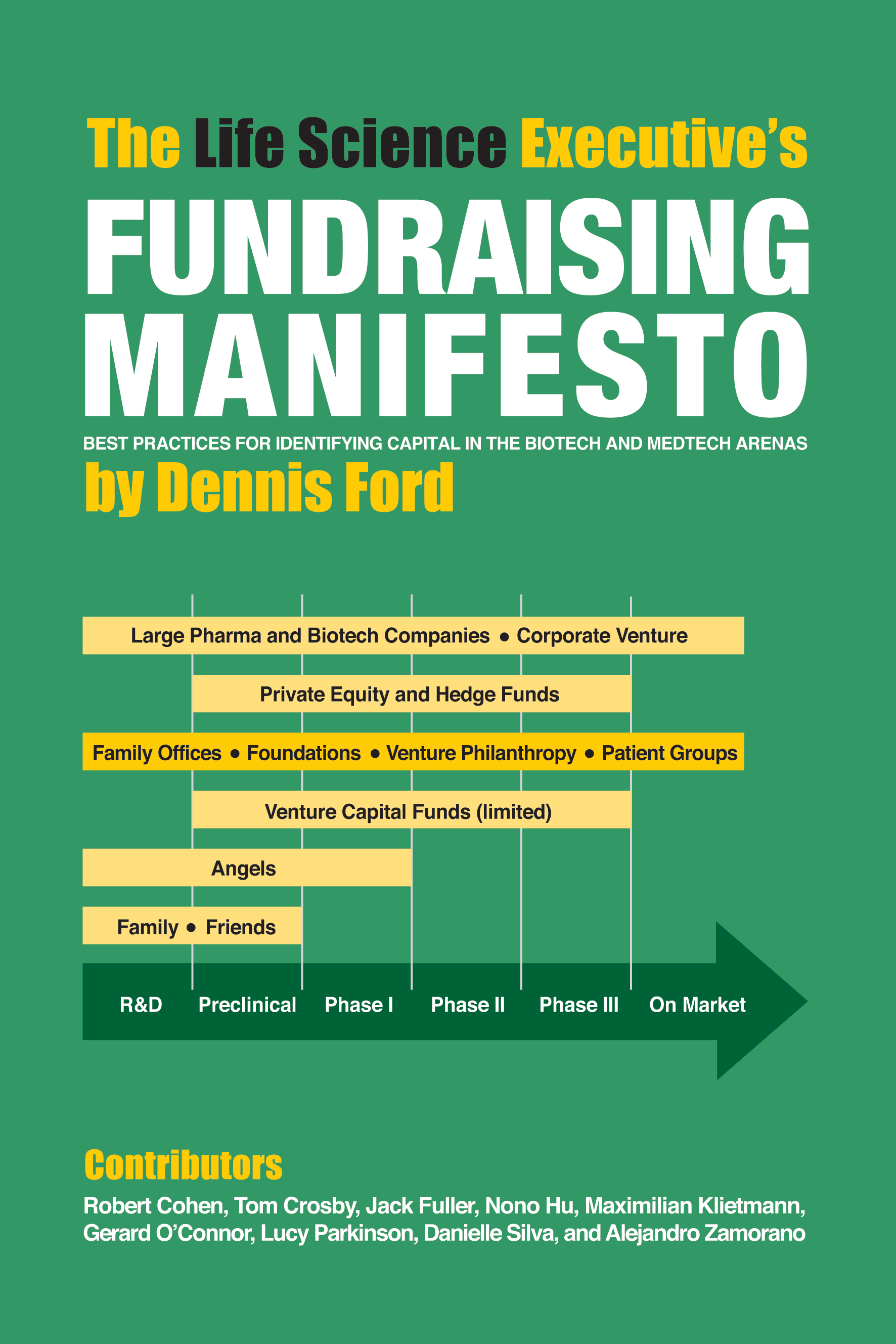
Raising capital is not a one-time event. It must be an ongoing part of your business strategy. The Life Science Executive’s Fundraising Manifesto reveals the expertise required to continually fundraise and bring your ideas to market.